
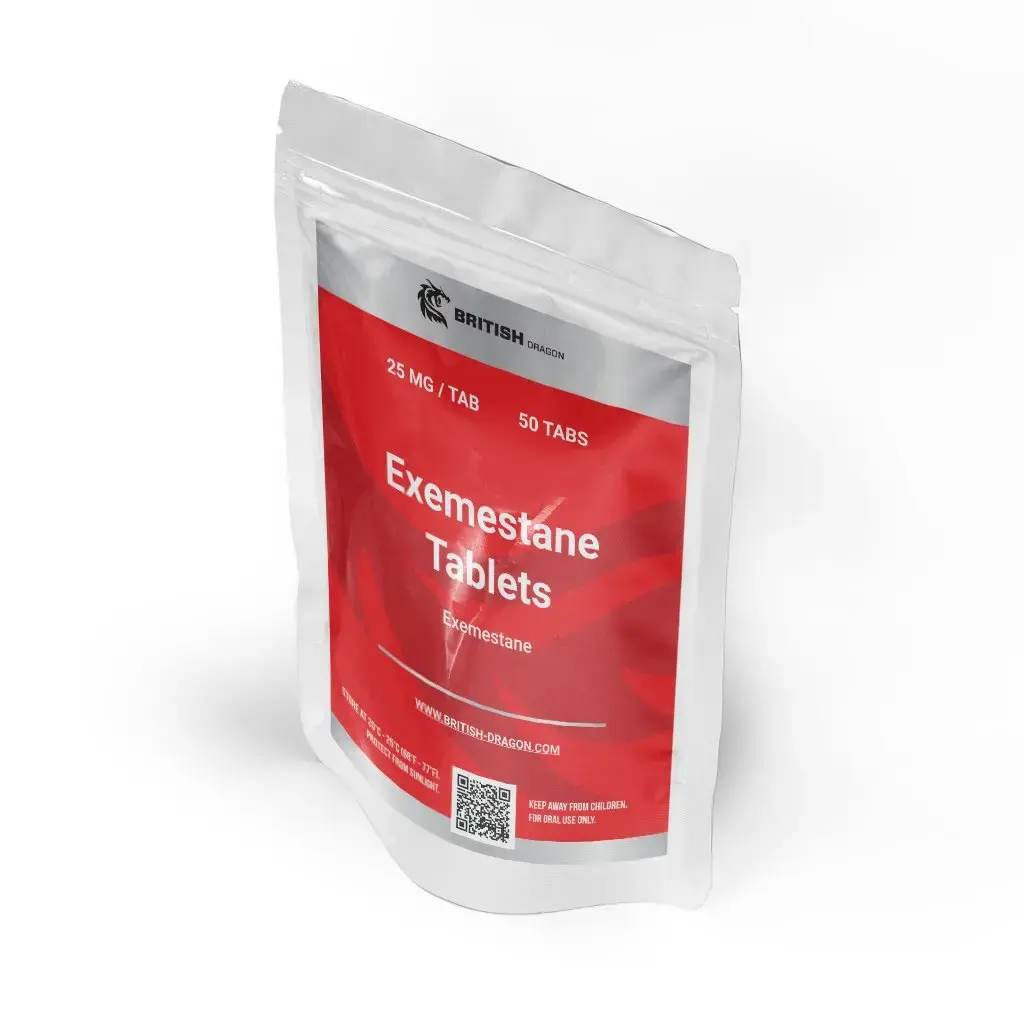
Exemestane 25 mg is an oral steroidal aromatase inhibitor tablet manufactured by British Dragon and dosed at 25 mg per tablet, supplied in packs of 50 or 100 tablets.
Exemestane 25 mg contains exemestane, a potent steroidal aromatase inhibitor that irreversibly binds to the aromatase enzyme (CYP19A1), permanently disabling its ability to convert androgens into estrogens . Unlike non-steroidal inhibitors such as anastrozole and letrozole, exemestane acts as a mechanism-based (suicide) inhibitor, meaning its effects persist until new aromatase enzyme is synthesized .
In clinical medicine, exemestane is FDA-approved for adjuvant treatment of postmenopausal women with estrogen receptor-positive early breast cancer, and for advanced breast cancer in postmenopausal women whose disease has progressed following tamoxifen therapy . The standard clinical dose is 25 mg once daily after a meal . In the TEAM trial, exemestane demonstrated efficacy comparable to tamoxifen with a different side effect profile, including higher rates of arthralgia and hot flashes but lower rates of thromboembolic events and vaginal bleeding .
In non-medical bodybuilding and performance-enhancement contexts, exemestane is commonly referenced as an aromatase inhibitor to manage estrogenic side effects during aromatizing anabolic steroid cycles. Its steroidal mechanism and lack of negative feedback on LH/FSH make it distinct from non-steroidal AIs . Such use falls outside approved medical indications and requires careful consideration of individual response.
Exemestane is a steroidal aromatase inhibitor that irreversibly binds to the aromatase enzyme, producing sustained estrogen suppression until new enzyme is synthesized .
Exemestane is a 6-methylenandrosta-1,4-diene-3,17-dione derivative that acts as a mechanism-based inhibitor of aromatase. It binds irreversibly to the enzyme's substrate-binding site, permanently inactivating it. Because the body must synthesize new aromatase enzyme to restore estrogen production, exemestane's effects persist even after the drug is cleared from circulation .
This mechanism distinguishes exemestane from non-steroidal AIs such as anastrozole and letrozole, which reversibly bind to the enzyme and whose effects diminish as drug concentrations decline. The clinical significance of this difference lies in the potential for prolonged estrogen suppression with exemestane, which may be desirable or undesirable depending on the context .
Exemestane has a terminal elimination half-life of approximately 24 hours, supporting once-daily dosing. Steady-state concentrations are reached within 7 days. The drug is extensively metabolized by CYP3A4 and aldoketoreductases, with less than 1% of the dose excreted unchanged in urine .
Exemestane is FDA-approved for specific breast cancer indications in postmenopausal women . Products marketed for research purposes are not approved for human use, and non-medical use falls outside approved indications.
British Dragon offers several ancillary compounds used in non-medical bodybuilding contexts. Anastrozole is a non-steroidal AI with reversible binding, while Letrobol contains letrozole, another non-steroidal AI. For post-cycle therapy, Clomiphene and Tamoxifen are commonly referenced for restoring endogenous testosterone production.
Exemestane's distinguishing characteristic among these compounds is its steroidal, irreversible mechanism, which may provide more sustained estrogen suppression and does not negatively affect LH/FSH feedback at moderate doses .
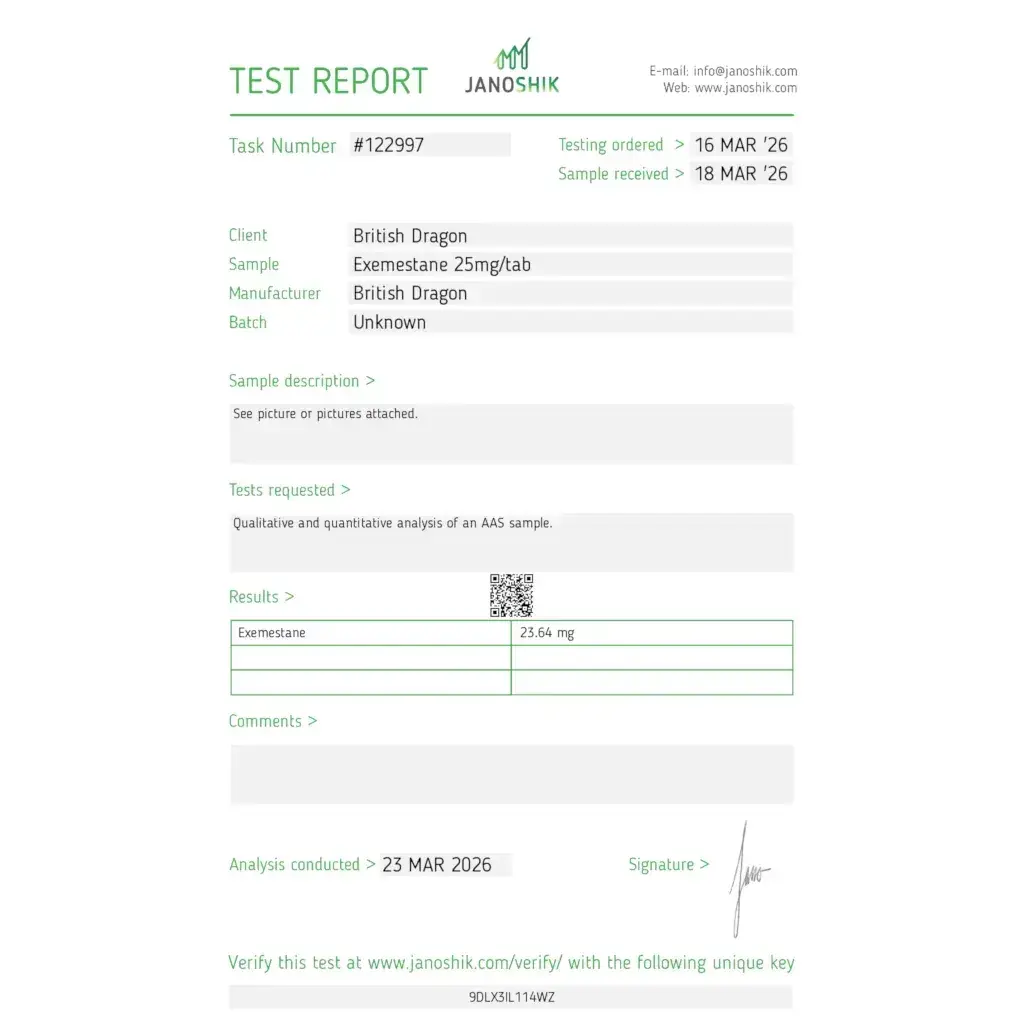
Published laboratory reports for Exemestane 25 mg are shown below with the test date, measured result and percentage of the product's 25 mg label claim.
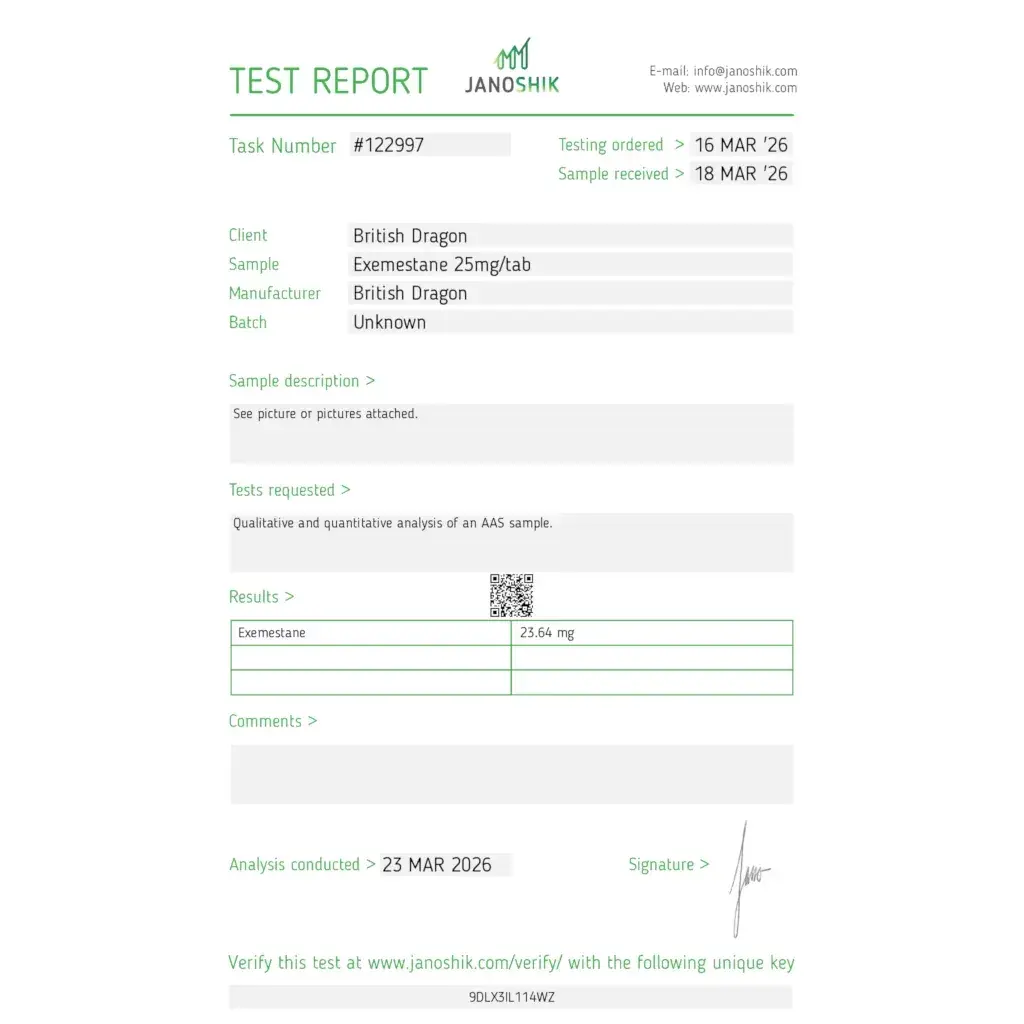 View Report
Laboratory results apply to the specific tested sample represented in each published report and should not be interpreted as a measurement of every tablet or production batch.
The information below is provided for educational reference only. Exemestane is a prescription medication; medical use requires appropriate diagnosis, clinical supervision, and ongoing monitoring. Non-medical use falls outside approved indications.
In clinical practice for breast cancer, the standard exemestane dose is 25 mg taken once daily after a meal . In non-medical bodybuilding contexts, exemestane is commonly referenced at lower doses for managing estrogenic side effects, typically 12.5 mg every other day or 6.25–12.5 mg daily, though such use falls outside approved indications and requires careful individual assessment.
| Use Case | Common Reference Range | Frequency |
|---|---|---|
| Clinical (breast cancer) | 25 mg | Once daily after a meal |
| Non-medical AI management (conservative) | 6.25–12.5 mg | Every other day or daily |
| Non-medical AI management (standard) | 12.5–25 mg | Daily or every other day |
These non-medical ranges represent community-reported practices and are not derived from controlled clinical trials for performance enhancement. Individual response to aromatase inhibition varies, and excessive estrogen suppression carries risks including joint discomfort, adverse lipid changes, and bone density reduction .
In non-medical bodybuilding contexts, exemestane is used alongside aromatizing anabolic steroids such as testosterone or Methanabol. The goal is to mitigate estrogenic side effects including water retention, gynecomastia, and elevated blood pressure while maintaining the anabolic benefits of the cycle compounds.
Exemestane should not be stacked with tamoxifen in clinical settings, as the combination may lower exemestane blood levels . In non-medical contexts, bloodwork including estradiol, lipid profile, and liver function is commonly referenced to guide AI dosing.
The most common adverse effects reported with exemestane in clinical trials include hot flashes (incidence 20–25%), arthralgia (15–20%), fatigue, nausea, and increased sweating . In the TEAM trial, exemestane was associated with higher rates of arthralgia and hot flashes compared to tamoxifen, but lower rates of thromboembolic events and vaginal bleeding .
Exemestane lowers estrogen levels, which may lead to loss of bone mineral content and increased fracture risk. Cholesterol elevations have also been reported . In non-medical contexts, excessive estrogen suppression can cause joint dryness, mood changes, and sexual dysfunction, which may be managed by adjusting dosage frequency based on individual response.
Exemestane has approved dosing for specific medical indications. Any information about non-medical use is derived from user-reported practices and is not validated by controlled clinical research. This information does not constitute medical advice.
Exemestane is a prescription medication with known risks that require clinical oversight. It is contraindicated in premenopausal women and during pregnancy .
Exemestane is contraindicated in women who are or may become pregnant and in premenopausal women, as it may cause fetal harm and offers no clinical benefit in this population . It is also contraindicated in patients with hypersensitivity to exemestane or any excipients .
Exemestane should not be used in combination with tamoxifen, as the combination may lower exemestane blood levels and reduce its efficacy .
Non-medical use of exemestane falls outside approved indications. Product purity does not establish that non-medical use is safe or appropriate for an individual. Estrogen suppression carries risks that may not be apparent without clinical monitoring.
Common adverse reactions (incidence ≥10%) in women taking exemestane include hot flashes, arthralgia, fatigue, nausea, increased sweating, and hypertension . In the TEAM trial, exemestane was associated with higher rates of arthralgia (20% vs 15%) and hot flashes (25% vs 20%) compared to tamoxifen, but lower rates of thromboembolic events (1.5% vs 2.5%) and vaginal bleeding (3% vs 6%) .
Exemestane lowers estrogen levels, which may lead to decreased bone mineral density and increased fracture risk. Cholesterol elevations have also been reported . In clinical trials, exemestane was associated with a higher incidence of osteoporosis and fractures compared to tamoxifen .
Serious adverse reactions reported post-marketing include hepatitis, cholestatic hepatitis, and skin reactions including urticaria and angioedema .
Exemestane is not appropriate for everyone. Contraindications include pregnancy, premenopausal status, and hypersensitivity to the drug . Caution is advised in patients with pre-existing osteoporosis, high cholesterol, or hepatic impairment .
Patients should inform their healthcare provider of any bone thinning or weakness, high cholesterol, or other medical conditions before taking exemestane .
Medically supervised exemestane therapy may involve monitoring of bone mineral density, serum cholesterol, and liver function . In clinical settings, the TEAM trial demonstrated the need for bone density monitoring in patients receiving exemestane .
Store tablets in a cool, dry place in the original packaging. Keep out of reach of children. Inspect tablets before use and do not use if they appear damaged or compromised.
Exemestane 25 mg is supplied through the official British Dragon distribution chain and shipped in original manufacturer packaging with discreet, privacy-focused handling.
The outer shipping package remains discreet, with privacy-focused handling and no unnecessary external product details. Products are supplied through the official British Dragon distribution chain.
To verify your Exemestane 25 mg product, use the security code on the packaging and cross-check it on the British Dragon official site. Official British Dragon presentation and original packaging help reinforce product legitimacy and buyer confidence.
For complete delivery details, tracking policy, and reshipment terms, please see our Shipping Info page.
Proper storage conditions help preserve tablet stability and overall product integrity throughout shelf life.
Store at controlled room temperature (15–25°C) in a cool, dry place, away from direct light and moisture. Keep tablets in their original blister packaging or container until use to protect from humidity.
Inspect tablets before use and do not use if they appear discolored, cracked, or otherwise compromised. Keep out of reach of children.
Answers to common questions about Exemestane 25 mg, the Exemestane compound, and its applications.
Exemestane 25 mg contains the steroidal aromatase inhibitor exemestane. In clinical medicine, it is approved for treatment of hormone receptor-positive breast cancer in postmenopausal women . In non-medical bodybuilding contexts, it is commonly referenced for managing estrogenic side effects from aromatizing anabolic steroids, though such use falls outside approved indications.
The standard clinical dose is 25 mg taken once daily after a meal for breast cancer treatment . In non-medical contexts, exemestane is commonly referenced at lower doses of 6.25–25 mg daily or every other day. These non-medical practices are not derived from controlled clinical trials for performance enhancement.
Exemestane is an aromatase inhibitor, not an anabolic steroid, and does not suppress endogenous testosterone production. Post-cycle therapy is not applicable to exemestane in the context of hormonal recovery. In non-medical settings, PCT protocols typically involve Clomiphene or Tamoxifen rather than exemestane.
Exemestane is a steroidal aromatase inhibitor that irreversibly binds to the aromatase enzyme (CYP19A1), permanently disabling its ability to convert androgens into estrogens . This mechanism produces sustained estrogen suppression until new enzyme is synthesized. It is distinct from non-steroidal AIs such as anastrozole, which bind reversibly.
Exemestane has a terminal elimination half-life of approximately 24 hours, and steady-state plasma concentrations are typically reached within 7 days of daily administration . Estrogen suppression begins rapidly after the first dose, though the irreversible mechanism means effects persist even after the drug is cleared from circulation .
There is no universally established "best" aromatase inhibitor, and each has distinct characteristics. Exemestane is a steroidal AI with an irreversible mechanism, while anastrozole and letrozole are non-steroidal AIs with reversible binding . In the TEAM trial, exemestane demonstrated efficacy comparable to tamoxifen with a different side effect profile .
Exemestane and Anastrozole are both aromatase inhibitors but differ in type. Exemestane is a steroidal, irreversible (suicide) inhibitor, while anastrozole is a non-steroidal, reversible inhibitor. Exemestane's effects persist until new enzyme is synthesized, and it does not negatively affect LH/FSH feedback at moderate doses .
Exemestane and Letrobol (letrozole) are both aromatase inhibitors. Exemestane is steroidal with an irreversible mechanism, while letrozole is non-steroidal with reversible binding. Letrozole is generally considered more potent at suppressing estrogen, while exemestane's steroidal structure may offer different side effect characteristics.
Exemestane 25 mg is the standard clinical dose for breast cancer treatment in postmenopausal women . In non-medical bodybuilding contexts, 25 mg is often considered a high dose for estrogen management, and lower doses or less frequent administration are commonly referenced to avoid excessive estrogen suppression.
Exemestane 25 mg is labeled at 25 mg of exemestane per tablet. It is supplied as oral tablets in packs of 50 or 100 tablets manufactured by British Dragon.
Yes. A published laboratory report dated March 23, 2026 measured Exemestane 25 mg at 23.64 mg, equivalent to 94.56% of its 25 mg label claim. The complete report can be viewed in the Lab Reports tab.